
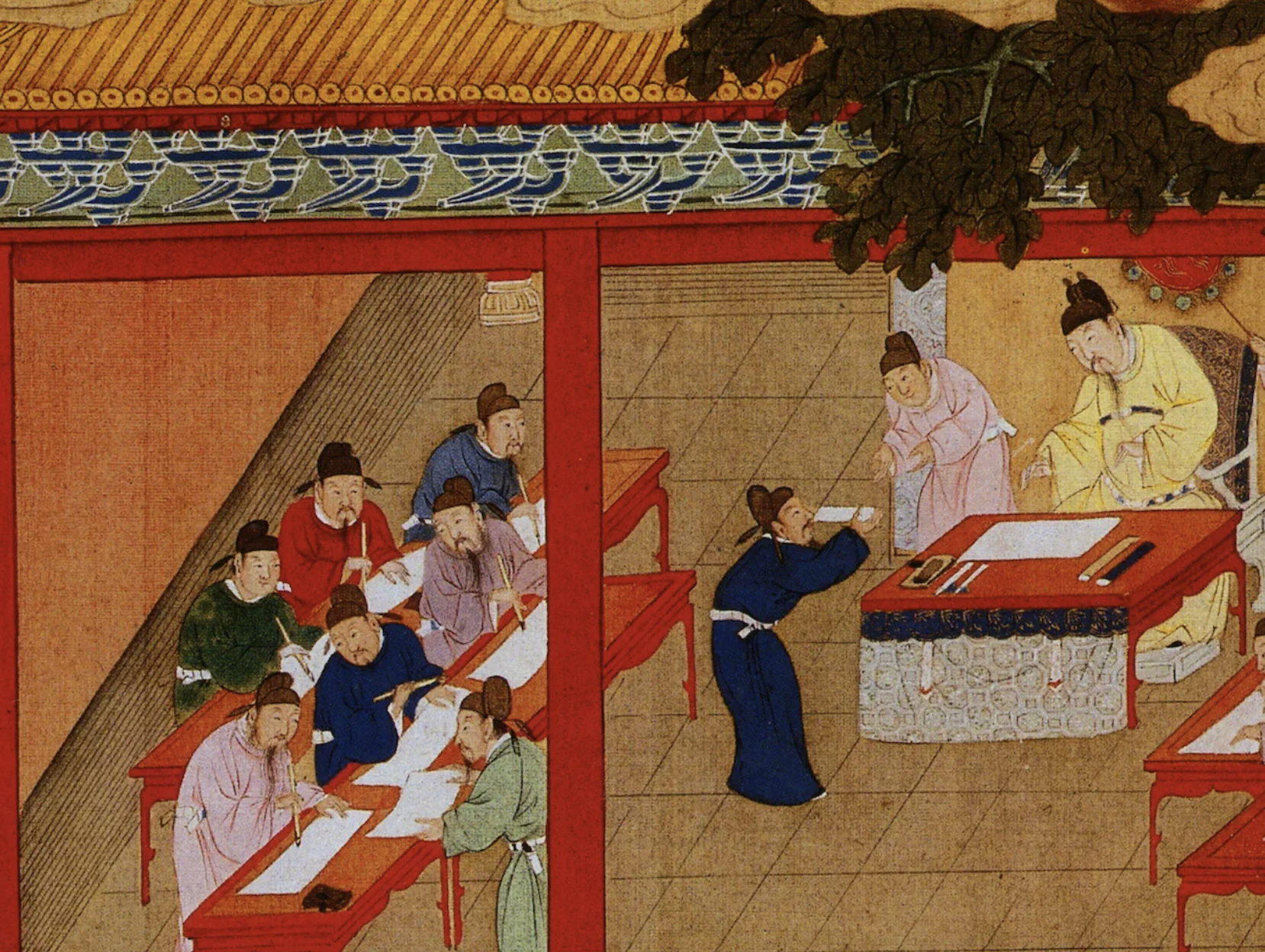
Write place, write time: Chinese imperial exam, 605 CE
The Imperial Chinese Civil Service Exam was a civil service examination system in Imperial China administered for the purpose of selecting candidates for the state bureaucracy. Deeply rooted in Confucian ideology, the examination sought to select the most qualified applicants, regardless of their familial upbringing. Due to the stringent requirements, there was only a 1% passing rate among the two or three million annual applicants who took the exams. Imperial examinations were not immune to corruption as well. In 1711, many sons of the major salt-merchant families passed the exams, leading those who failed to accuse the governor-general and the deputy examiner of accepting bribes; they were found guilty and subsequently put to death.
In this committee, you will explore both the official and unofficial forces surrounding the examination system, representing the Ministry of Rites, a body of imperial officials, examiners, governors, censors, and bureaucrats tasked with preserving the legitimacy of the examination process while maintaining political stability within the Qing Empire.
pietro stabile
chair
Pietro is a fourth-year student at the College, majoring in Computer Science (because he likes computer science) and Economics (because he likes being employed). He hails from Barrington, Illinois, a profoundly unremarkable suburb of Chicago. Last year, Pietro served as Chair for Terror in Terranova, the Ad-Hoc committee at ChoMUN XXIX, and previously as a chair for Not That Castro: Cipriano Castro's Cabinet, 1902 at ChoMUN XXVIII, and as an Assistant Chair for the 1997 Asian Financial Crisis at ChoMUN XXVII. He also served as Under-Secretary-General for Regional Bodies and has chaired the NATO committee at UChicago’s high school conference, where he thoroughly enjoyed the gavel’s power — don’t worry, he promises not to overdo it for ChoMUN. Surprisingly, Pietro also has a life outside Model UN — he performs research for a lab at UChicago, does data analysis for the environmental sustainability club, is an avid film and digital photographer, and enjoys cooking Italian food to convince himself he is cultured. Pietro cannot wait to see everyone at this year’s conference, and he looks forward to the tenacity and creativity delegates will bring to the table.
Send your questions, concerns, and cat or dog pictures — but not both — to pietrostabile@uchicago.edu. Pietro never reads his emails, but he swears he’ll read yours.
Pei-hsiang Chris Tien
crisis director
Chris is a fourth-year student at the University of Chicago studying linguistics and architectural studies, while also doing the pre-med program. Originally from Taiwan, he has a wide range of interests, and MUN is a major part of it. His MUN journey started in middle school, when he was 13 years old. Over the years, Chris has now served as an assistant chairs and chair at multiple ChoMUN conferences, including the Terror in Terranova Ad-Hoc Committee at ChoMUN XXIX! Outside of MUN, Chris enjoys dancing and fashion, as well as taking photos as a photographer. Finally, he dabbles in origami and enjoys talking about arts and sports while going on side quests!
If you have any questions, please do not hesitate to reach out via email: christien@uchicago.edu.
rudra patel
crisis director
Rudra is a fourth-year student at the college, majoring in Economics and Data Science. He started MUN in college and really enjoyed doing crisis breaks for his first conference (CHOMUN 27). Throughout his time at college, he has run multiple committees ranging from GAs on climate policy to crises involving animals. In his free time, he loves to do
sidequests. Origami, badminton, and trash cleanups are all part of his weekly schedule! You may also find him being a tour guide at UChicago. Overall, he enjoys the creative niche that MUN offers and is very excited to run his last committee for CHOMUN this year!
If you have any questions, please do not hesitate to reach out via email: rudrapatel@uchicago.edu.
Secretariat oversight:
khushi bora, under-secretary-general